Vampire Survivors: Legacy of the Bloodmoon — In-Depth Review
Vampire Survivors: Legacy of the Bloodmoon expands the beloved bullet-heaven formula with a dark, atmospheric twist centered around the ominous Bloodmoon cycle. This review breaks down what works, what falls short, and whether the expansion is worth your time and money.
Gameplay & Core Loop
At its heart, Legacy of the Bloodmoon retains the hypnotic loop that made the original Vampire Survivors so addictive: pick a character, survive waves of ever-escalating monsters, level up, and chase powerful weapon evolutions. The controls remain deliberately minimalist — movement is your only direct input — yet the depth of decision-making during level-ups keeps every run feeling consequential. New players will grasp the basics within minutes, while veterans will immediately notice the expanded roster of weapons and passive items that open up fresh build paths.
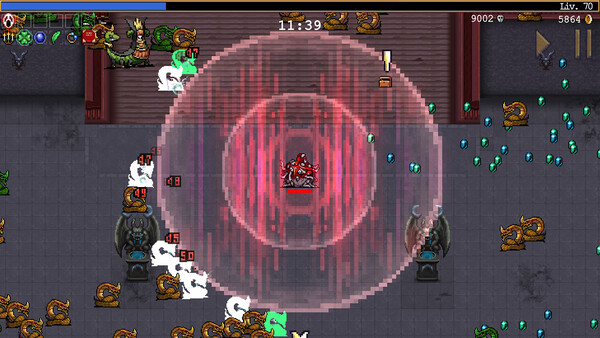
The signature addition is the Bloodmoon mechanic itself, a timed phase that periodically washes the battlefield in crimson light and dramatically shifts enemy behavior. During a Bloodmoon phase, standard foes become faster and more aggressive, elite variants spawn more frequently, and certain weapon evolutions gain temporary amplifications. This creates a satisfying rhythm of tension and relief that the base game sometimes lacked in its mid-run stretches, giving players a reason to plan their builds around specific windows of heightened danger.
Where the gameplay stumbles slightly is in pacing during the early minutes of a run. Before builds come online, the opening waves can feel overly familiar if you have spent significant time with the original. The expansion leans heavily on its mid-to-late game spectacle, and while that payoff is substantial, the ramp-up could benefit from a faster hook.
New Content & Bloodmoon Mechanics
Legacy of the Bloodmoon is generous with new content. The expansion introduces a sizable cast of new characters, each with unique starting weapons and passive bonuses that encourage distinct playstyles. Several of the new survivors are tied to the Bloodmoon lore — unlocking them requires completing specific challenges during Bloodmoon phases, which adds a welcome layer of goal-oriented progression beyond simply surviving longer. The new weapon evolution trees are among the most creative in the franchise, rewarding players who experiment with unconventional item pairings.
The Bloodmoon Elders serve as the expansion's marquee boss encounters, and they deliver. Each Elder has multi-phase attack patterns that demand more spatial awareness than the base game's bosses ever did. These fights feel like genuine skill checks rather than gear checks, and they provide some of the most memorable moments in the entire Vampire Survivors experience. The dedicated boss arenas, with their shifting hazards tied to the Bloodmoon cycle, add environmental storytelling that enriches the otherwise minimal narrative.
Co-op multiplayer, both local and online, rounds out the content offering. Team-based runs with role synergies — one player focused on crowd control while another stacks single-target damage — add genuine strategic depth. The co-op balance is mostly well-tuned, though certain character combinations can trivialize content that was clearly designed for solo play.
Visuals, Audio & Atmosphere
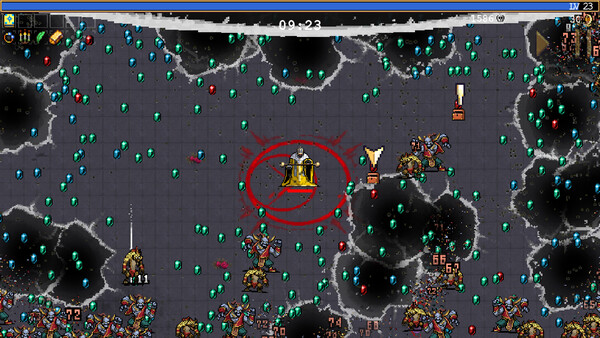
The pixel-art aesthetic has been refined rather than reinvented. New stages feature darker, more gothic environments that feel thematically cohesive with the Bloodmoon concept — crumbling cathedrals, fog-choked graveyards, and cursed forests bathed in deep reds and purples. The Bloodmoon transitions themselves are visually striking, with the screen gradually shifting to an ominous crimson palette that immediately communicates the danger escalation without any UI element needed.
The soundtrack deserves special praise. The new tracks blend orchestral intensity with retro synth elements, and the dynamic music system that ramps up during Bloodmoon phases is genuinely effective at amplifying tension. Sound design for the new weapons is satisfyingly crunchy, and the audio feedback loop of collecting experience gems and triggering evolutions remains as compulsive as ever. The overall atmosphere is noticeably moodier than the base game, which leaned more comedic — this tonal shift will appeal to players who wanted a darker edge.
Performance & Technical Polish
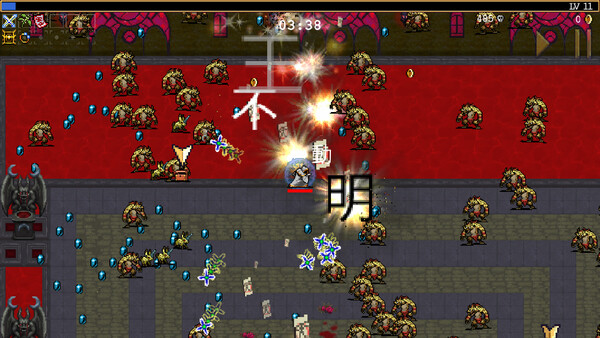
Performance is largely solid across platforms, though the late-game particle density that defines the Vampire Survivors experience can still push hardware during the most chaotic Bloodmoon phases. Players on lower-end machines may notice frame dips when multiple evolved weapons proc simultaneously against dense enemy clusters, particularly during co-op sessions where the on-screen entity count effectively doubles. The developers have included several performance-tuning options, including particle density sliders, which help mitigate the worst spikes.
On the stability front, the expansion launched in a reasonably polished state. Save progression is reliable, and we encountered no run-ending bugs during our testing. Loading times are minimal, and the seamless transition into Bloodmoon phases happens without any hitches. A few minor visual glitches — weapon projectiles occasionally clipping through terrain boundaries — persist but do not meaningfully impact gameplay.
Verdict — Is It Worth It?
Vampire Survivors: Legacy of the Bloodmoon is a confident expansion that understands what made the original special and builds meaningfully upon it. The Bloodmoon mechanic adds a strategic pacing layer that veteran players will appreciate, the new characters and weapon evolutions significantly expand build diversity, and the Bloodmoon Elder boss fights represent the franchise's highest-quality encounters to date. The co-op mode, while not flawless in its balance, transforms the solitary survival experience into something genuinely social and fun.
The expansion is easiest to recommend to existing fans — if you enjoyed the original's hypnotic loop, this is more of it with sharper teeth. For newcomers, the base game remains the better entry point, as Legacy of the Bloodmoon assumes familiarity with core systems and ramps its difficulty accordingly. At its asking price, the sheer volume of content — new characters, stages, weapons, bosses, and the co-op mode — represents strong value, especially for players who measure their enjoyment in hours of replayable runs.
Legacy of the Bloodmoon does not reinvent the bullet-heaven genre, nor does it try to. Instead, it refines and deepens a formula that millions of players already love, wrapping it in a darker atmosphere with enough new systems to justify returning to the grind. For most players, that is exactly what a great expansion should do.